The D-Day Landings hold a special significance for Jersey. Often, those at the centre of history have no time to realise it, or indeed be appreciated for the essential part they each played in creating history and changing the course of world events.
Although they took place 80 years ago, starting in the early hours of 6th June 1944, the Normandy landings (known as Operation Overlord) should remain uppermost in our minds, and with good reason.
The beaches of Normandy are only a few miles away from us in France, and they remain globally significant as the site of the allied military campaign which witnessed the largest naval, air, and land, operation in history.
Whilst ‘Overlord’ did not bring an end to the war in Europe, it did commence the process through which victory in World War II was eventually achieved.
The military operation that led to the eventual liberation of Europe resonates strongly with us, with Jersey’s own liberation from occupation having taken place on 9th May 1945, the 79th anniversary of this having been marked last month.
The numbers are staggering to imagine. The Allies used more than 5,000 ships and landing craft to land 150,000 troops on five assault beaches in Normandy; Utah, Omaha, Gold, Juno and Sword. What an astounding experience it must have been to play a part in the Normandy Landings, but what a terrifying experience, too.
We know that British armed forces played a central role in D-Day and the Battle of Normandy, and more than 22,000 men made the ultimate sacrifice for freedom in this campaign, with more than 4,000 allied deaths occurring on the first day.
Amongst these staggering numbers, it is believed that around 60 soldiers, sailors and airmen from Jersey were involved in the battle. Just over a decade ago, 38 of them formed the Jersey Normandy Veterans’ Association.
Warfare offers little time for reflection. However, now we have time to consider those individuals who all played their part and to think of all those we know who have made sacrifices for what is often called “the greater good”; to defend principles and ways of life that thrive on tolerance, political democracy and peaceful government.
Whilst few amongst us can still recall the impact of the Normandy Landings, living in Jersey, we all benefit from a liberty that, we may take for granted daily. And yet signs of this are everywhere – in the way we live, the numerous languages we speak, in the flags we fly.
The sight of the Freedom Tree at the waterfront, so near our own beaches, exemplifies freedom, growth, and renewal. A visit to the Jersey War Tunnels recalls the reality and starkness of Jersey’s own occupation.
Surely, D-Day on 6th June 1944 was a catalyst for eventual Victory in Europe (VE) Day on 8th May 1945 and the beginning of a flicker of light in the darkness of conflict.
Today, we may be geographically further from the theatre of war, but we still live in a world marked by conflict. We think of those we know affected by the ongoing war in Ukraine, and of the continuing fighting between Israel and Palestine. Many of us remember the Falklands conflict, and growing up when the Troubles in Northern Ireland were brought into sharp focus on evening news bulletins.
We should not turn our backs and say, “it’s in another country” and continue to take the peace that we enjoy for granted.
To recall the D-Day landings some 80 years ago is take us back in time. It is to pay our respects.
We must not forget those who helped shape what Jersey is today, on the beaches of Normandy, a place of freedom for so many to call home. The past is not another country.
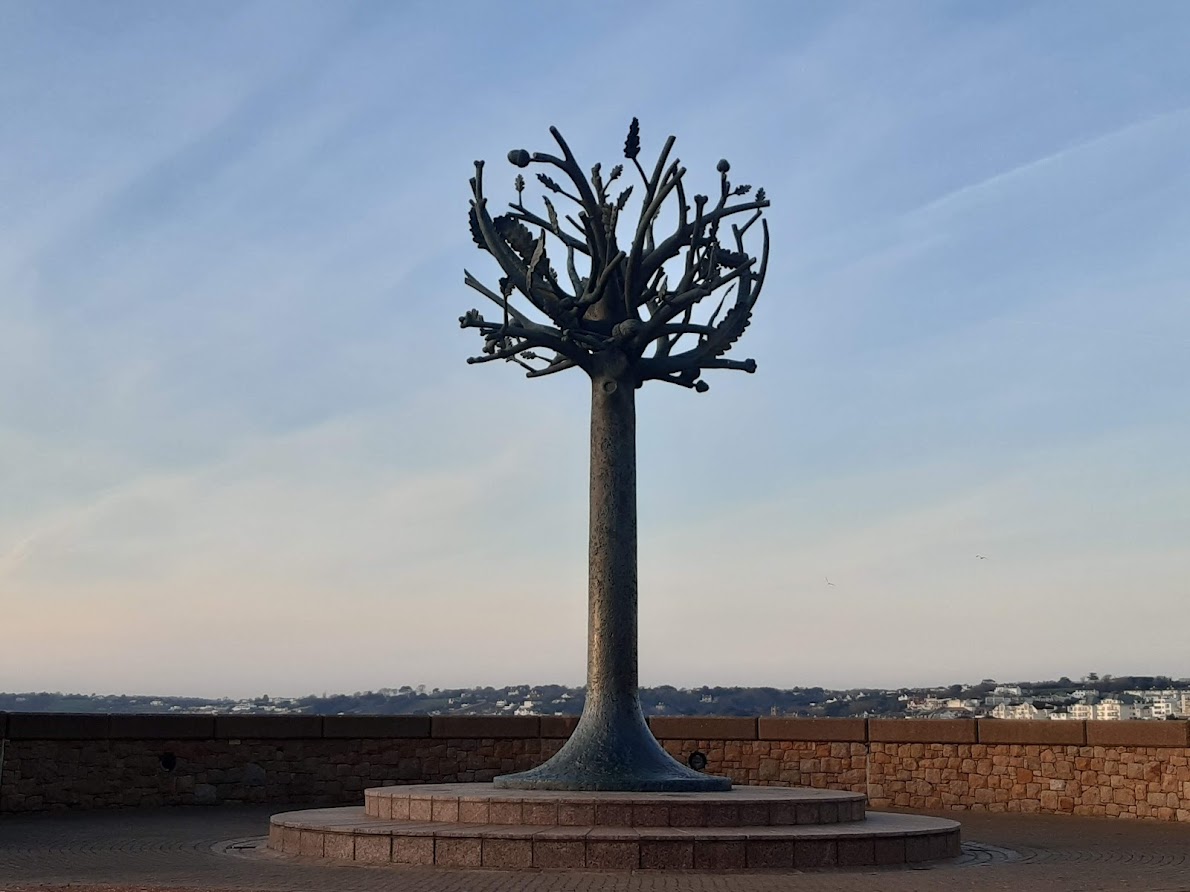
Freedom Tree, Jersey
 Sarah Nibbs